Córdoba, day one: Caliphately Fabulous
Cake and coffee and a knife and fork.
I had a very long sleep. An obscenely long sleep. I hadn't expected to be quite so tired after just short of 36 hours on various trains literally doing nothing but sitting or lying down, grazing, or actually sleeping, but here we are.
The bells from the Mezquita-Catedral, probably, woke me at about 8:10am – a strange time by all accounts – with a peal of clattery bells that lasted only for a couple of minutes but which was loud enough to wake the dead and then stop, as if to pretend that nothing had happened. I went back to sleep and woke up a little later when it was more quiet. A fitting start to what turned out to be an incredibly lazy day.
What I saw of the morning was sunny, and in my earlyish-morning search for caffeine, I stumbled out my hotel and almost directly into a coffee place on the square just outside my hotel, la Plaza de la Trinidad, where I devoured a cheap and tasty Spanish equivalent of a chocolatine without use of the knife and fork that had curiously been provided. A nice long coffee helped wash that down, and I had time to linger in the cream-and-ochre square, watching the students of the Escuela de Arte y Superior de Diseño going about their morning rituals – which mostly appeared to be comparing hair colours, perching artistically on anything but the sitting part of metal benches, and competitive vaping.
I am very happy indeed with my choice of hotel. After umming and ahhing over a couple of options, I booked the Hospedería Luis de Góngora while I was on the train from Barcelona. It was most definitely a gamble which paid off. My room is small but functional, with a window that opens into the courtyard below and which floods the room with light nearly all-day long, until there is none more to reflect from the white walls around us. I have a double bed which is firm but comfy, with sheets so tightly tucked that I suspect they may have been nailed to the mattress. Getting into bed is an enjoyable challenge, second only in difficulty to trying to get out of it in the morning.
It's always good to look at the bathroom first to see whether people have thought about your stay in advance, and I can say they have. The shower is generously sized, almost Italian in style, with decent water pressure and piping hot water to round everything off. There's a massive mirror over the sink, which comes with a hairdryer for clearing the glass, and enough towels to assign one to each limb. All this, for just 25€ a night. Bargain.
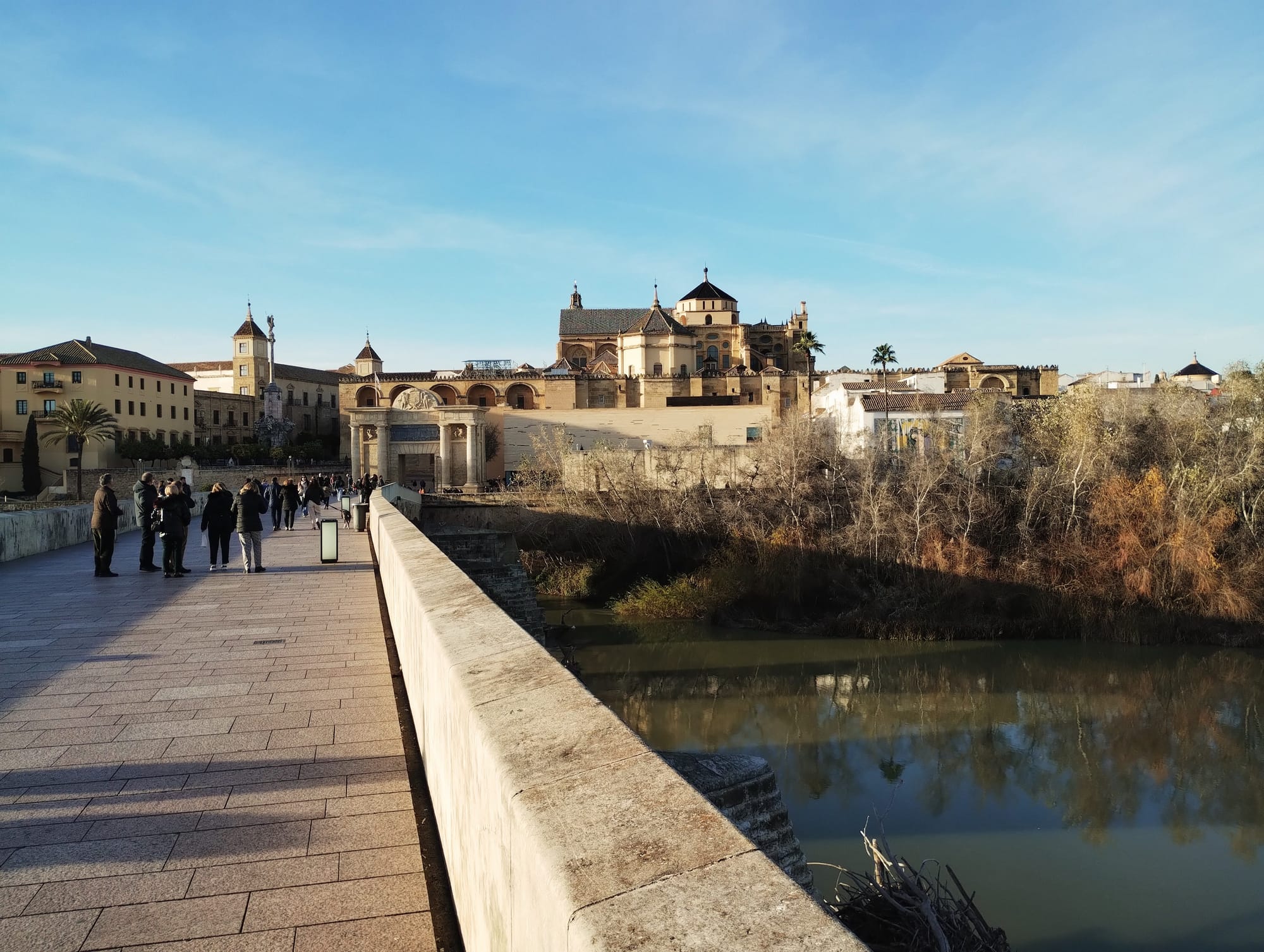
Córdoba is Spain's 12th-largest city, and the third-largest in Andalusia. At first a Roman colony, it was – importantly – conquered by the Muslims in the eighth century, who immediately set to building lots of pretty things with horse-shoe arches. It became the capital of the Caliphate of Córdoba, and became a centre of education and learning, growing to be Europe's second-largest city by the tenth century. The Mezquita-Catedra – which was once a church, then a mosque, but is now a cathedral again – is the colourful heart of a Unesco World Heritage Site which encompasses the whole historic centre of of the city.
It is extraordinarily pretty, and wandering around the tiny cobbled streets, it's easy to be transported across the water and into North Africa. I spent my afternoon roaming aimlessly, getting wonderfully lost, and trying to find my bearings in the colourful labyrinthine streets that make up the old town. I poked around the free bits of the Mezquita and determined that I'd probably visit tomorrow as I don't have any lessons until the evening. With that in mind, I headed over the Roman bridge past the Calahorra Tower and into the Miraflores district in search of street art. There is not much street art listed in the app here, but along my travels I stumbled upon various little things which were nice to look at, and ticked off the ones in the app that I came to easily.
By six o'clock it was still light and remarkably warm, and I sat under an orange tree wondering whether anyone ever eats them. As the light dropped, so did the temperature, and once safely north of the river again, I found a street of bars full of hardy locals enjoying tapas and ice-cold glasses of Estrella Galicia. I thought it would be a good idea to sit down outside De Tapas to work out how things worked. You don't order your tapas, like you do elsewhere, but instead wait for a man to bring a tray of things which might be to your liking. My vegan virtue from the Eurostar was immediately undone by some innocent-looking chips which had bacon bits hidden under the sauce.
I lack the Spanish to protest, so I ate them until something else, inevitably and inextricably meat-heavy, came and then decided I'd finish my pint and find the kebab shop I walked past last night on my way from the station. A lovely falafel wrap cost just 4€, although the excitement was killed slightly when I happened to turn round just to see the proprietor hauling a massive sack of falafels out of a chest freezer behind me. Nonetheless, it was very tasty and I scored it quite highly because the spicy sauce lived up to expectations.
On my way back to bed, I found that some of the old doors into the Mezquita don't shut properly, so it's possible to peer through the gaps and have a gawp at what is to come.